The Hitchhiker's Guide to Aurora… and Iceland
- Author: Leo Mo
- Published: August 2, 2026
- Tags: Europe, Iceland, Stargazing
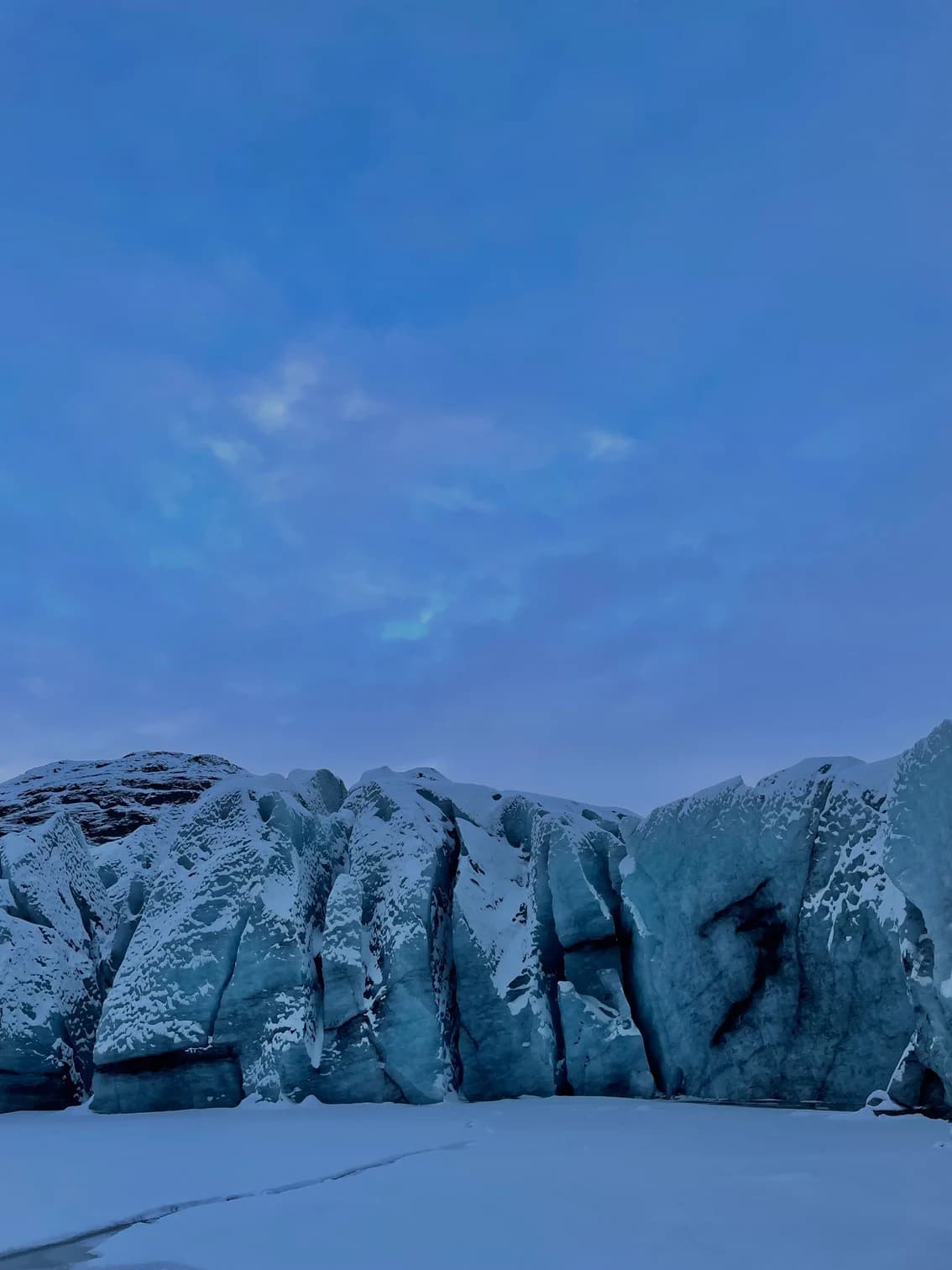
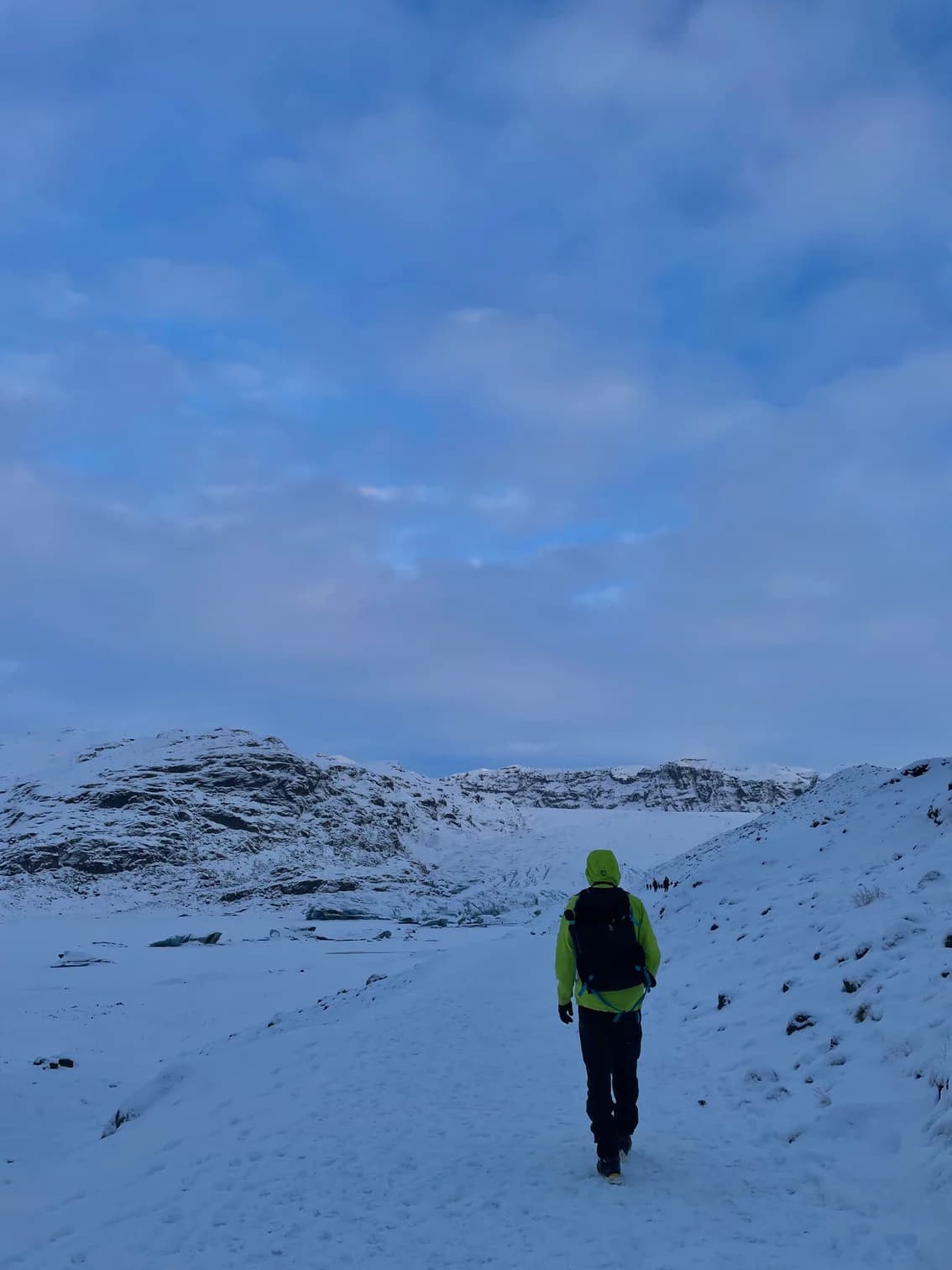
The sky turning from sauvage blue to boundless black, the coarse Earth changing from glacial azur to volcanic noir — it’s been days since we roam on Iceland, from drylands of hays to plains of snow, from the crib of the sea to the shoulder of the volcano.
The night was so black, you’d think the atmosphere was gone and we were now floating in the universe.
“God, it’s so cold out here,” Kexin flinched within her white puffy jacket. Below her fur hat, her face rosy under the unforgiving Icelandic wind.
“Are we gonna see aurora tonight?” Ginny asked, her periphery filled by the vast dark sky with stars. The stars were the brightest she had ever witnessed, yet no sign of illuminating stripes in sight.
“Positive,” I said, not even looking up. My head hung low to observe the cloud map and KP level prediction on digital screens, believing the miraculous lighting show wasn’t just a matter of fate. In the universe, destiny is a meticulously calculated trajectory.
“Do we need to drive any further?” Lodovico asked.
“We’ll have it here,” I said, staring at the greenness on the picture taken by a camera — the same spot where only a batch of gray existed in my naked eyes.
Joris came close, skeptical. “How can you even tell?”
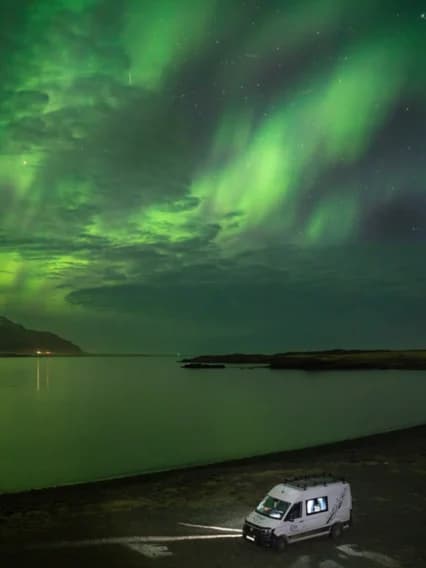
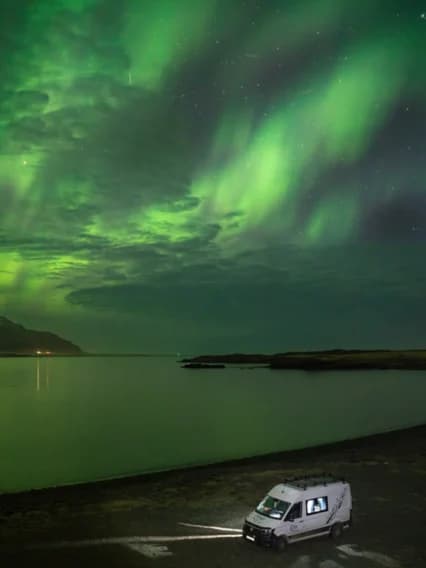
On a black field, our caravan was the only dot of light. Five faces behind the warmth-fogged pane, we stared at the pitchblack-ness, detecting each faint milky hue.
I finally looked up, eyes full of stars. “Just sit back and trust me. I have the hitchhiker’s guide to aurora… and Iceland.”
Why solar activity matters
Winter of 2023, spring of 2025 — they were the times we followed our insatiable desire to explore Iceland, and the times when the sun was exploding a little bit more than usual.
Eleven years is the cycle of the sun’s solar wind activity, which follows a bell-curve shape of fluctuation, with the peak of the bell spiking from late 2023 to 2026.
“Why do we care about the solar winds?” Joris asked.
“What even are solar winds?” Kexin followed.
Our sun, glorious and life-blessing, is under constant nuclear fusion, and flares out millions of tons of charged particles per second — blasting the universe like a strong whirl of solar wind. Earth is in the way of those charged particles, charged with energy, like a man with his face up in a tempest, ready to be showered. Yet the solar wind isn’t a spring shower, but a deadly acid rain. It would have stripped away our precious atmosphere, that thin blue lifeline, should it not be for the protection of our magnetic activity.
Yes, thanks to the perpetual dance of our molten core, electromagnetic lines have now woven a forever protective veil around Earth. This invisible veil, full of threads to detour charged particles, makes sure our atmosphere is not bombed by the solar wind. Those particles, guided by the electromagnetic lines, end up meeting our atmosphere in polar areas. Their power charges up the air molecules and releases light and energy, like a celestial banquet lighting show.
“Wait, wait, wait,” Kexin said, hugging a bucket of popcorn we’d prepared back on the campsite. “So the charged particles from the sun are attracted by the magnetic lines of the Earth, which is how they wind up in the polar sky….”
“Because electricity and magnets always attract each other,” Ginny added.
“And the energy inside the particles is released when they meet air,” Joris concluded.
“Which is why we care about the cycle of solar activity,” hands on the wheel, Lodovico said. “In fact, 2025 and 2026 are said to be the strongest years of solar activity not only in the past 11 years, but also in the past 30 years. Which is why it’s a good time for aurora hunting.”
“That might be a marketing scheme orchestrated by the Nordic countries to boost tourism…” I said, scooping the vanilla ice cream inside the car, too warmed up inside, “but we checked the papers — in any case, we are within the peak years of the 11-year cycle for sure. A solar wind storm means an aurora storm.”
I then waved my phone in front of them, showing the KP level indication inside an aurora prediction app, such as My Aurora Forecast. KP level indicates the intensity of solar activity at a given moment: the higher the value, the stronger the aurora. Ever since we landed here, we were checking the numbers every day, and it was only getting stronger. In the past few days, the KP level had been steadying around 3.
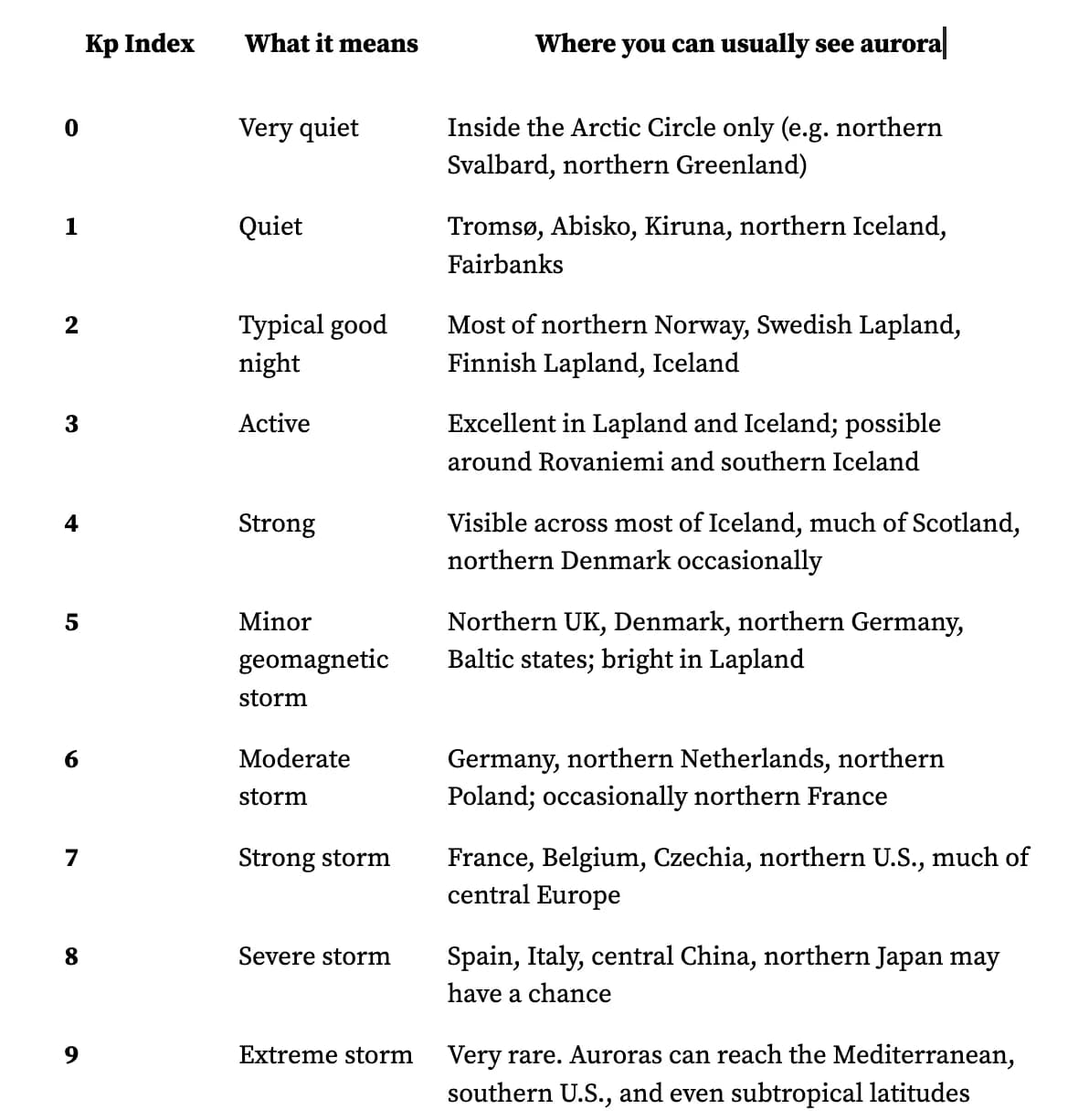
2025 was the year where news often reported sightings of auroras even as far south as suburban London and Paris — because the KP level, on the most random days in 2025, could reach 5 or 6.
Following the camera into the dark
“Aurora storm you say…” Ginny snuck her head out into the crisp cold, searching for any glint of green. The world was so quiet she could almost hear her own thoughts verbalised. She thought of the grand views of this planet she had witnessed.
In the past few days, we had driven from Reykjavik all the way to the northeast, staying in a different campsite every night — as it’s illegal to do wild camping — eating sandwiches and instant noodles, showering at campsites and dipping in wild hot springs, and just meandering every day to look at the magnificent age marks of Earth: rough volcanic rocks freshly out of the Earth’s womb, icebergs in gradient blue and sometimes capturing a chunk of black magma inside, gigantic waterfalls unfrozen in winter, warmed from running.
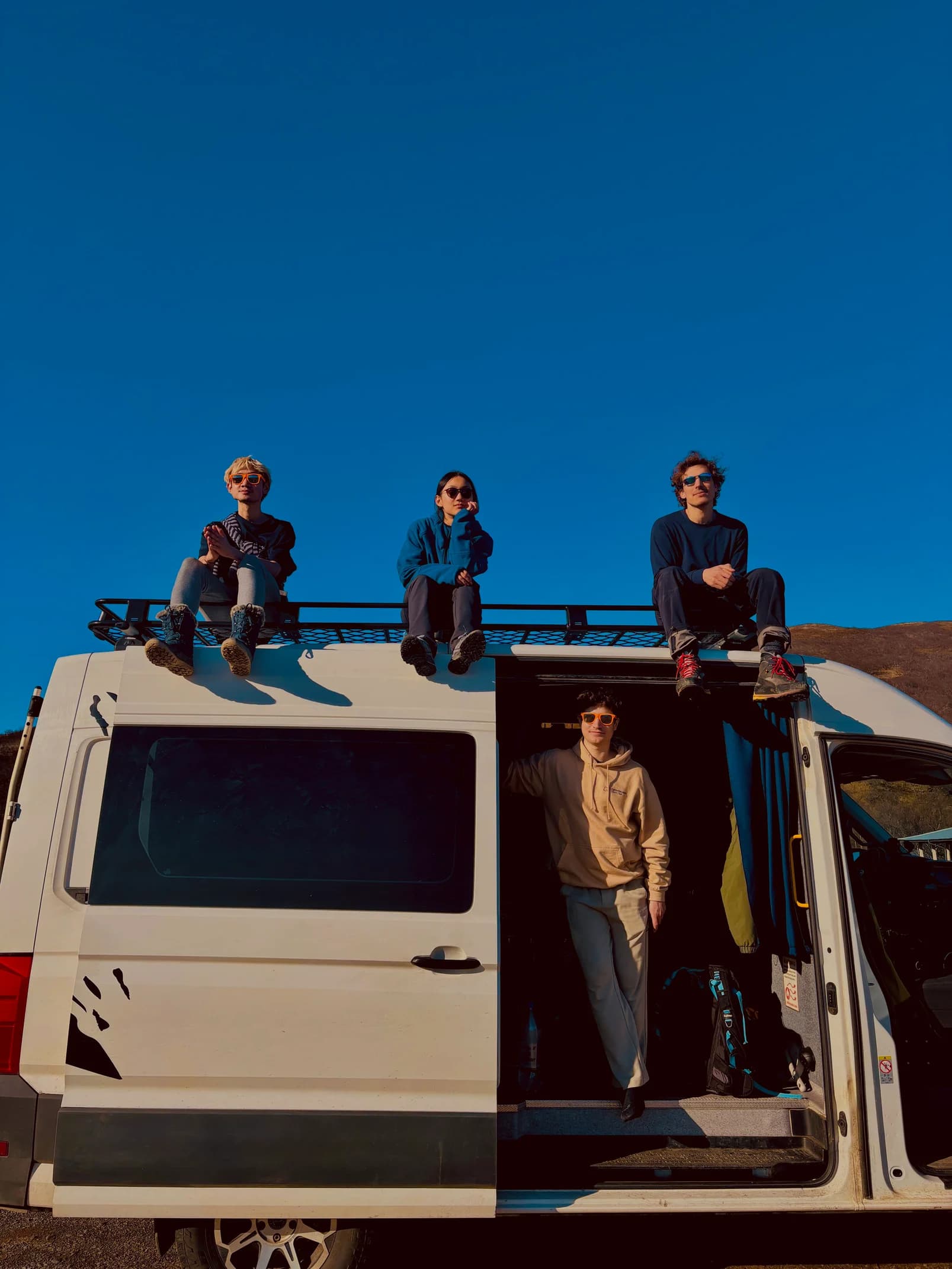
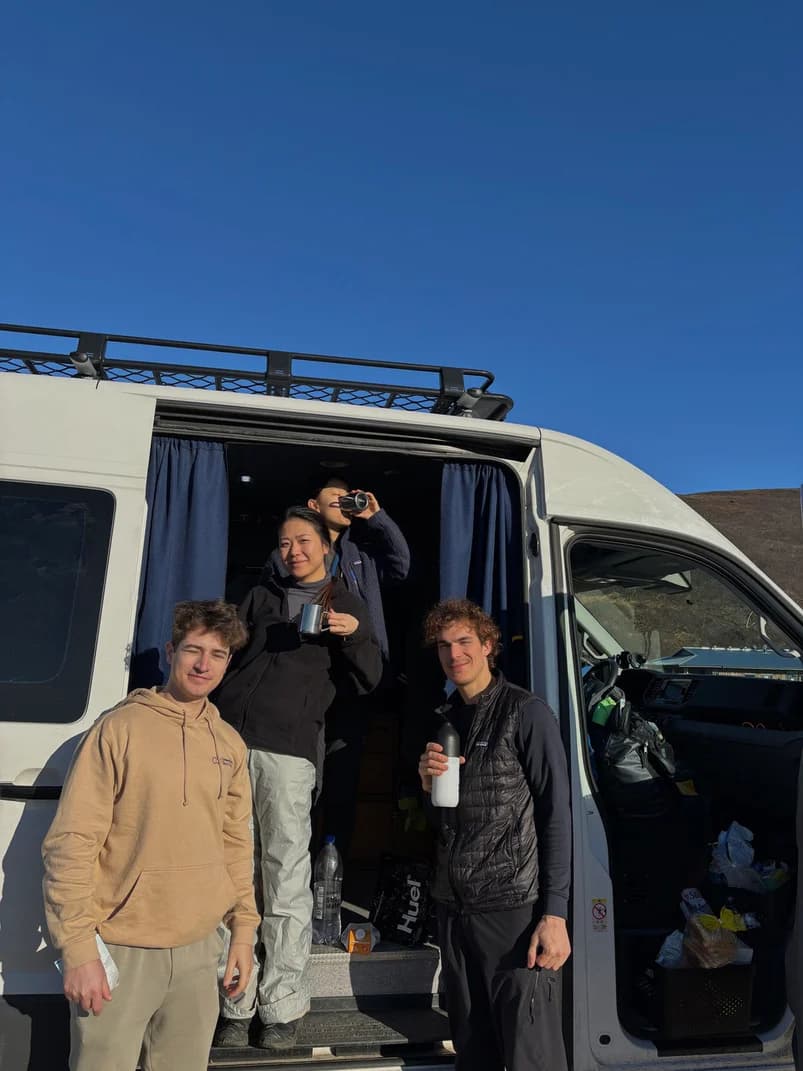
Right here, the broadness of the view had gradually become the broadness of our hearts, uncaged by city thoughts and urban stress.
As much as Ginny appreciated this elevation, born from being part of the wilderness, she couldn't help but stare at the bleak dark sky and ask, “Where is this aurora storm then?”
I held up my iPhone and took a picture of the darkness ahead of us, and showed it to her. “It’s coming, the storm.”
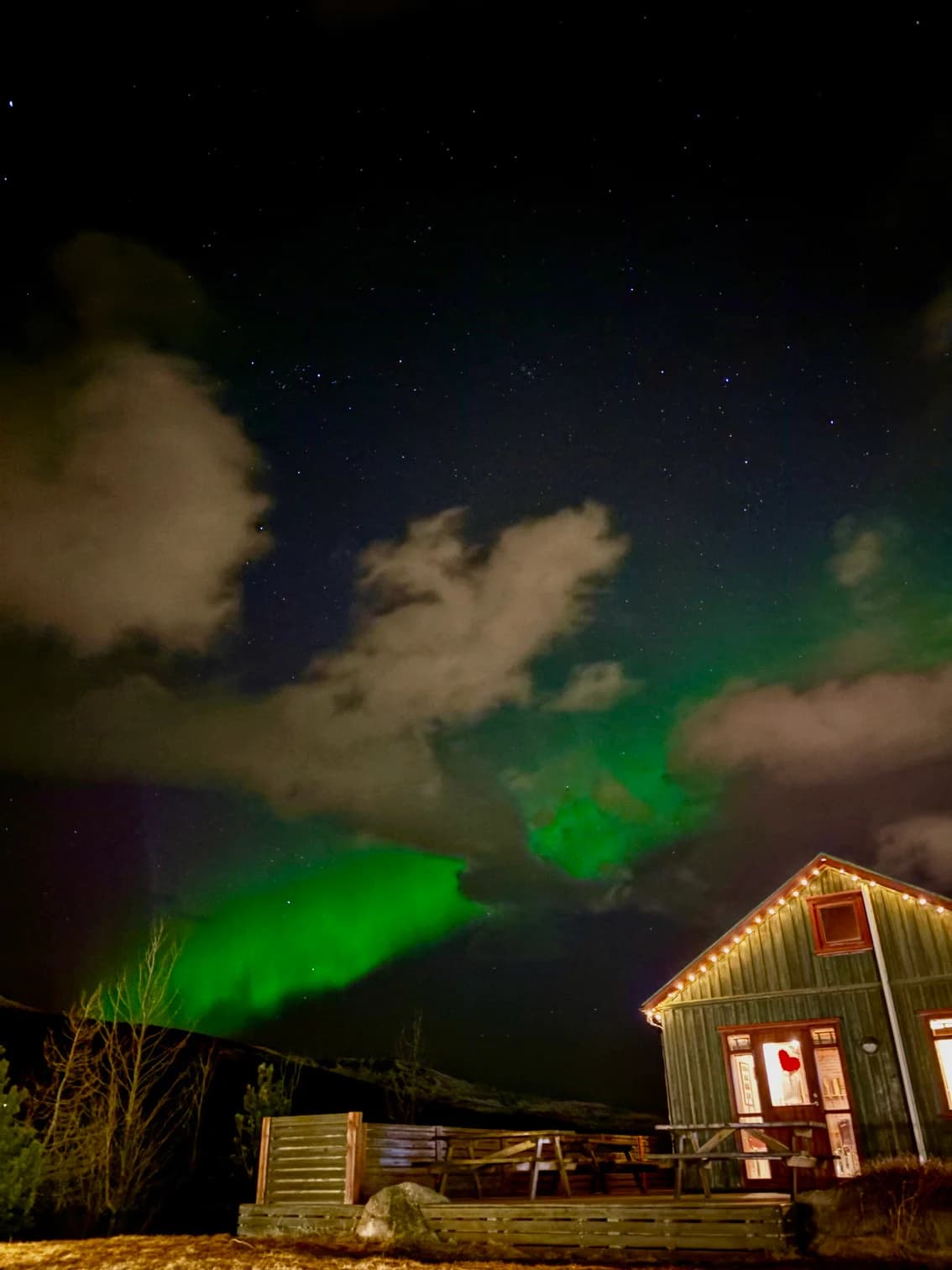
Kexin and Joris were shocked when they saw the picture I took — on my screen a pool of emerging green was inked on top of the dark sky. “But…” Joris had to double check the sky again, “there’s nothing green now.”
“That’s the camera trick,” I smirked. “Professional cameras, even your smartphones, are more sensitive to greenness than our naked eyes, so it could be a good trick to detect if there are already some green lights happening mid-air, even if still invisible for now.”
Just two years ago, in the snow-blanketed land of Norway, our car sat on the shoulder of a frozen road, as Lodovico set his camera to be even more sensitive to the green spectrum and took a picture of every direction. He examined each picture carefully, one by one, frowning more and more. “Any luck?” Ginny asked. As Lodo finished skimming the last picture, where some murky gray shadow was mixed with the charcoal clouds, he shook his head. “Let’s drive somewhere else,” he said, looking back up. Back then, the camera trick basically told us there was no aurora bubbling behind the sky.
“It’s true…” Kexin also tried with her phone, taking a picture of the dark east, and saw a veil of green on her screen. “Your phone showed more green though. That’s enough Instagram-worthy.”
“So this is a good spot,” Lodo confirmed after taking a picture with his eight-thousand-euro camera lens too.
“No, guys,” Joris spoke up, clouds in his eyes. “We have to leave.”
Clouds, moonlight, and finding the right spot
“Why?” I asked. Joris held up his iPad to show us the website of Icelandic meteorology in real time, on which a dynamic map of greenness and whiteness moved against each other. “See? This is the cloud coverage prediction. Right now we still have a clear sky, but if we fast forward the time — clouds are coming our way and will be masking us for the next few hours. We should drive away from the clouds.”
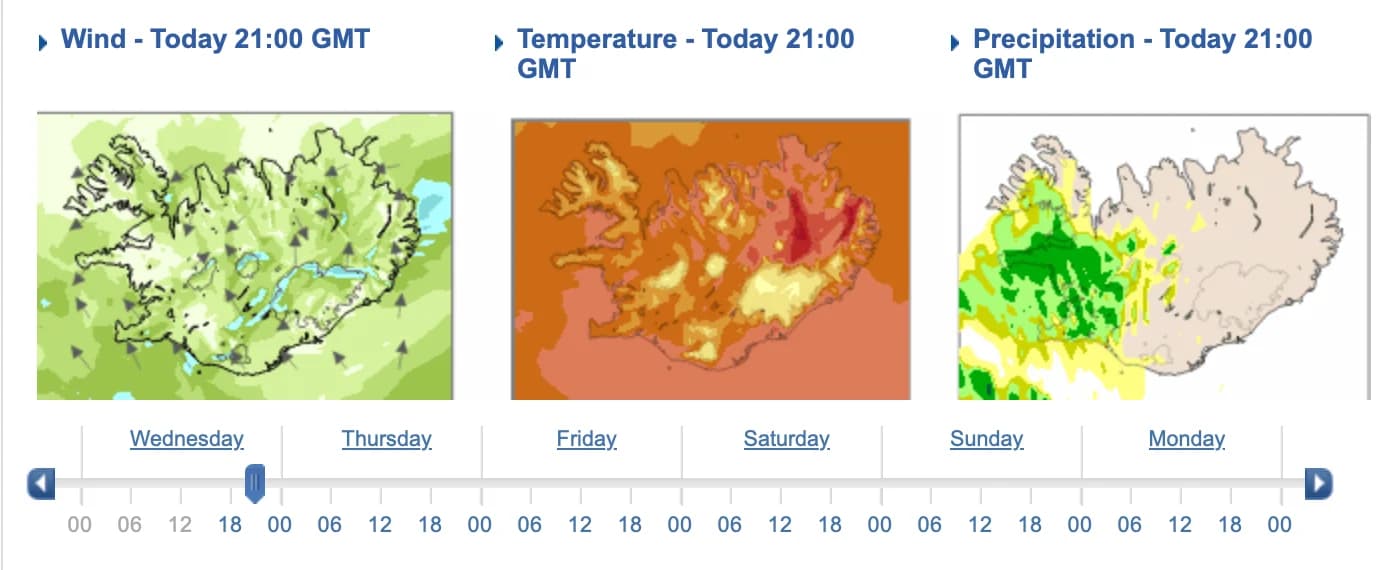
Real-time websites of local cloud movement are another key aspect in the hitchhiker’s guide to aurora. Clouds can obstruct your views, however strong the aurora, therefore you shall know where to go to be under clear skies. It resulted in our golden partnership for aurora road trips — one person checking the maps and cloud maps to determine where to go, and the driver following the instructions.
The ideal location should be away from light pollution, easy to park and step outside, and under clear skies.
It’s also why it’s recommended to go to polar areas around spring or fall — for example, going to Iceland in March. The weather is less extreme in spring, and you still have enough nighttime, whereas in winter, despite the long dark hours, snowstorms might linger over the sky.
If need be, we ought to pay attention to the moon too.
“The moon is magical,” I said, “but sometimes we need to make a decision between the moonlight and the aurora light.”
“How do we do that?” Kexin asked.
“We can use any app about moon phases to check the fullness and brightness of the moon, at any given time and location. And we might need to embark on a journey that only a few humans would do — drive away from it, into the darkness.”
“So where should we go?” Lodo asked, starting the car, ready to dive into the dark night again.
“Hmm…” Staring at the cloud map and the actual map, Joris stammered over the Icelandic place name.
“Are you having a stroke?” Kexin said.
“Just go here…” Joris showed the phone to Lodo. “I don’t know how to pronounce any Icelandic names.”
“Nobody knows…” Ginny said.
A celestial banquet
We could tell the sky was clear now because the stars were here. In March in Iceland, I could see Jupiter, Mars, Gemini behind Pollux and Castor, Orion’s belt, Sirius, the Pleiades, and constellation Leo.
“Are you gonna give us another unsolicited lecture about the stars?” Ginny said, also staring straight at the sky.
“In a sense… but this time, it’s about a planet. Remember how the aurora happens?”
“The sun blows electricity towards us and our magnetic lines take the electricity to the north,” Kexin said.
“Yes…” I said, staring at the copper glint in the sky next to Gemini, “so on Mars, in the past millions of years, there were aurora everywhere in the sky, all the time, until this grand celestial lighting show vanished, signifying the death of the planet’s atmosphere.”
“Why?”
“Because due to an unmoving core, Mars lost its magnetic field long ago, so the solar wind used to bombard its atmosphere directly, resulting in an aurora show everywhere, all the time. Until its atmosphere was fully stripped away by the solar wind. The beautiful aurora show was, in fact, the very proof that its atmosphere was slowly dying.”
“That’s so… romantic and cruel at the same time,” Kexin said, also looking at the Gemini I pointed out.
“But when is our turn to see aurora?” Joris asked. “We followed everything in the hitchhiker’s guide and hitchhiked until here.”
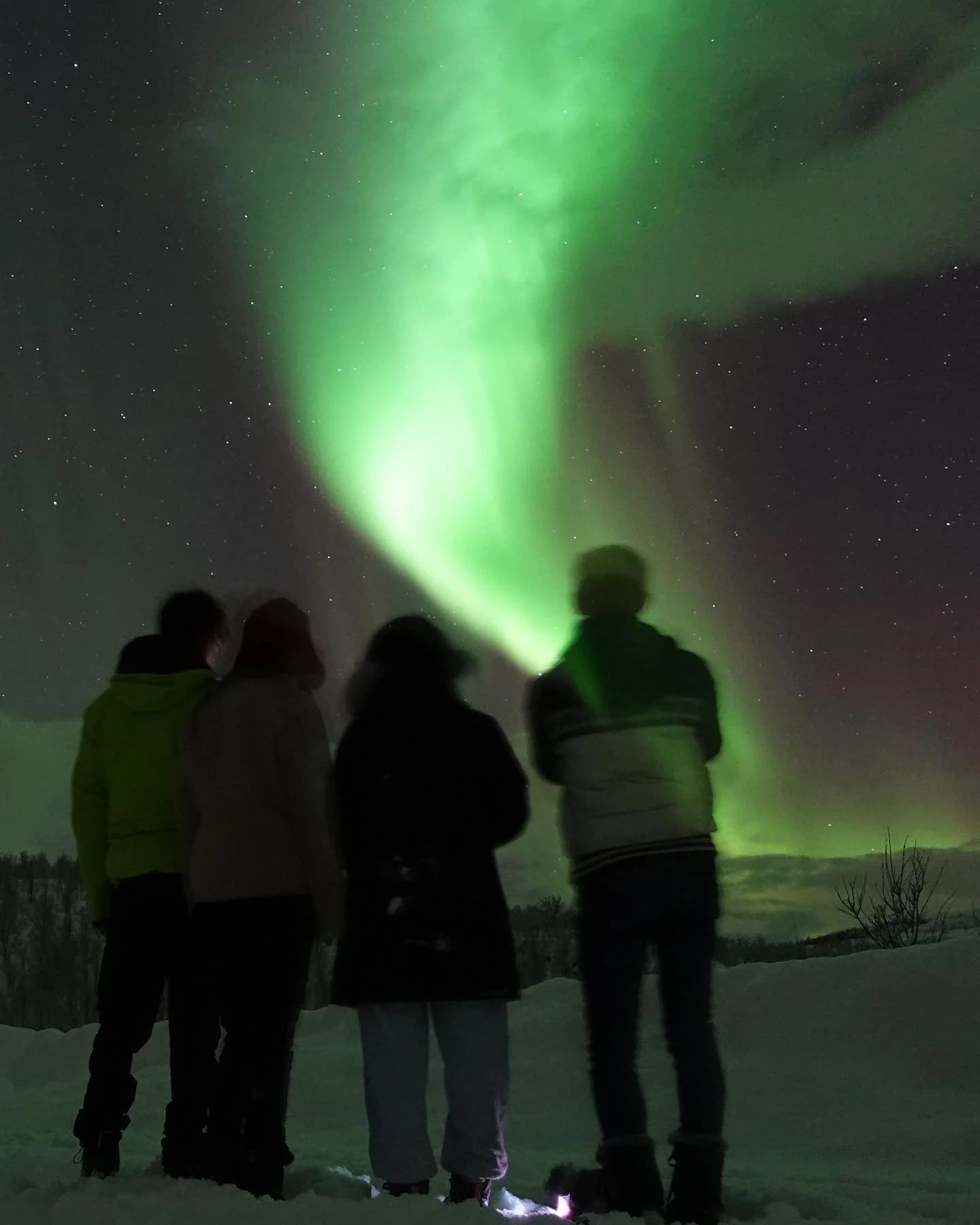
Then Lodo turned off the car light. Suddenly, before us, floated a celestial banquet.
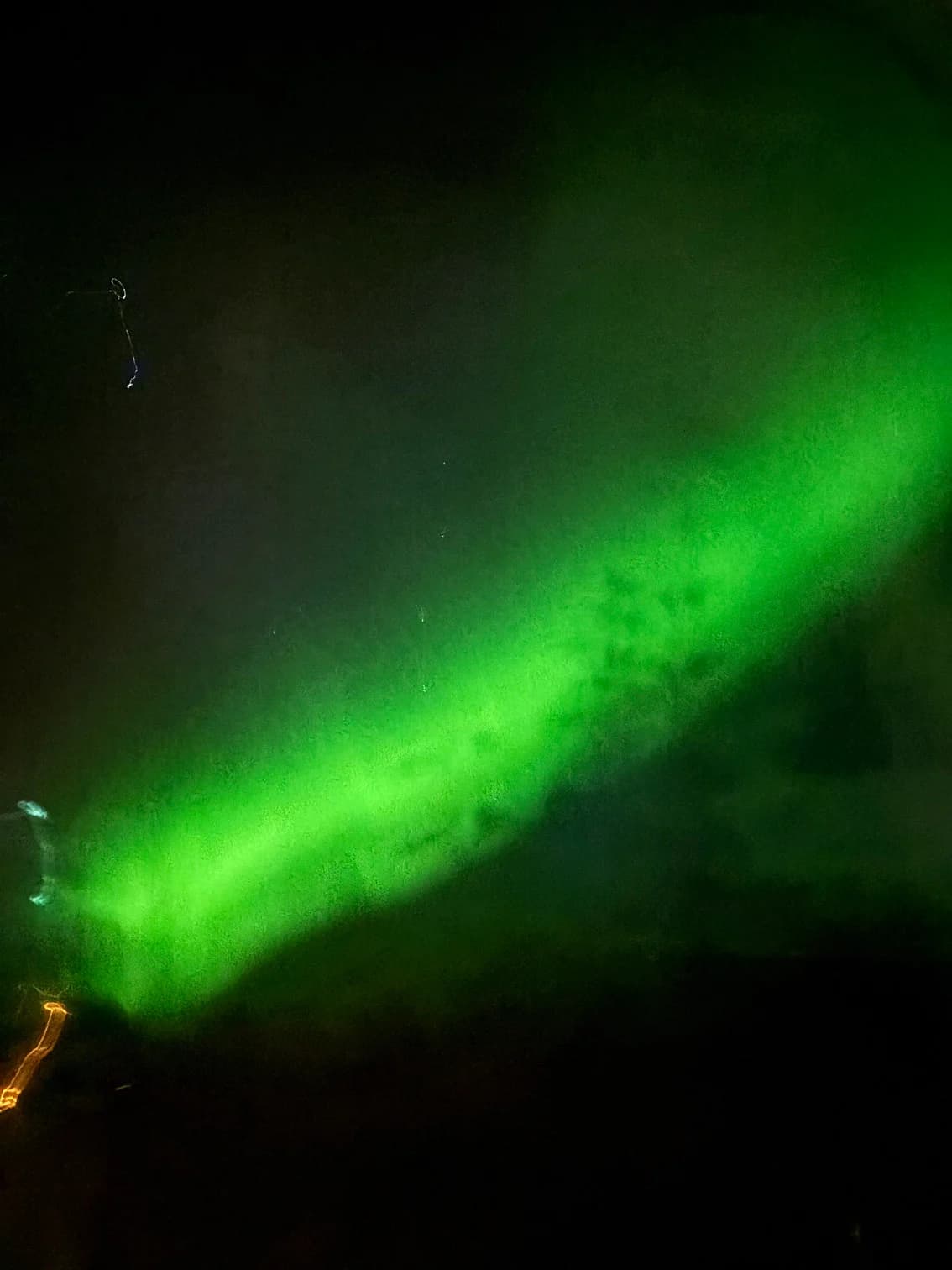
A strip of neon-green light thinly shone in the sky, putting on a green-yellow veil on the stars. It was so clear we could see the aurora strip dance: it had plenty of tiny “folds” and they all sped towards the same direction.
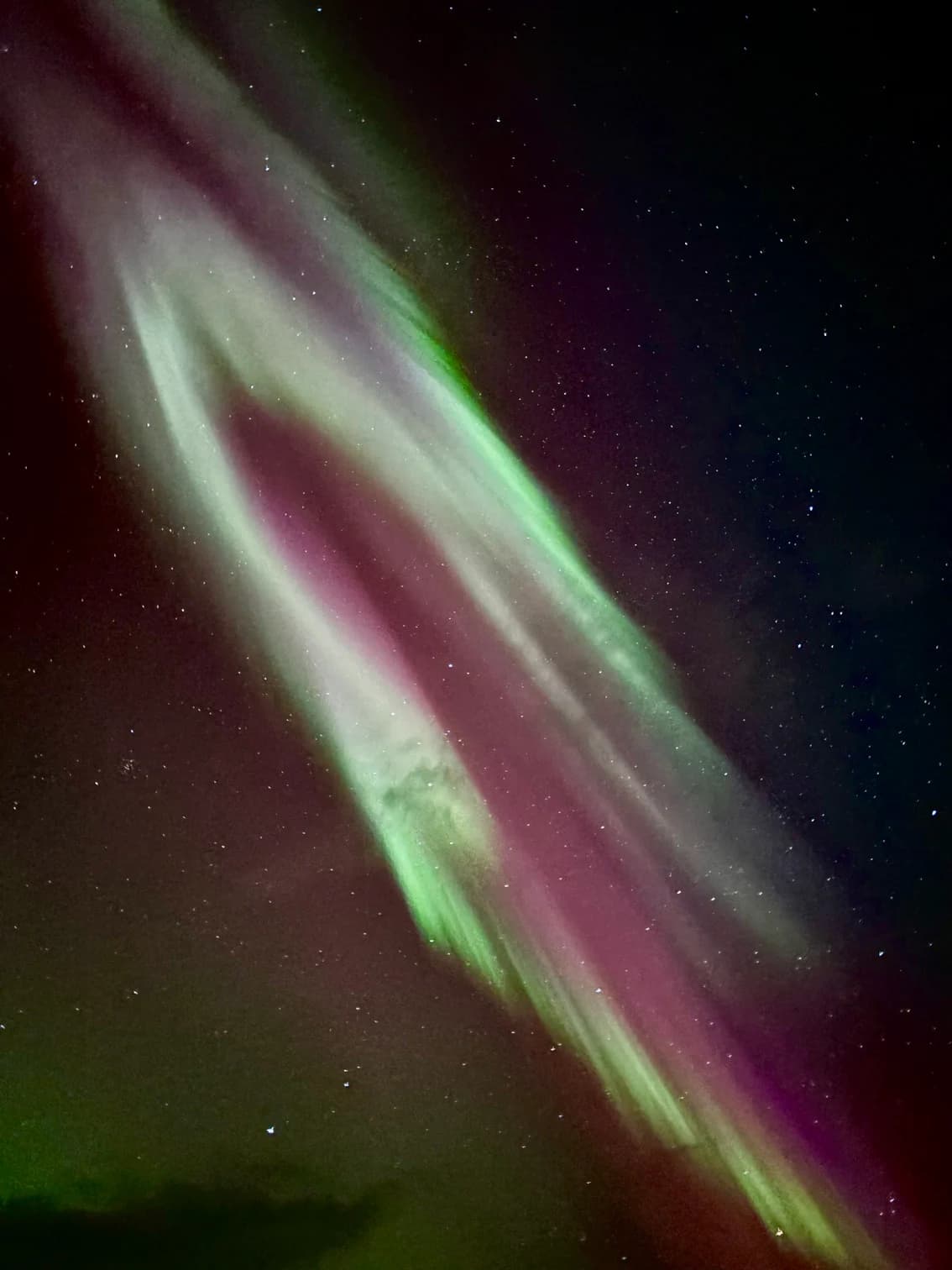
At some time the long bright green stripe even curved in the middle, as if blown by the same wind that blew on our faces.
We stood in the cold and in awe, staring at the moving lights above, the only sound being the howling wind, the only colors being the aurora. The northern light was, in fact, not yet as green as we’d seen in photographs; it was more like a milky opaque green — but the luminosity felt stronger than in photos.
“Remember to put on more clothes, guys,” Kexin reminded us, realizing we didn’t pay attention to how long we’d stayed outside of the car.
“It’s actually… very bright,” Joris said. “I feel like it’s shedding light on us even.”
Kexin noticed some pink hue at the far edge of the sky. She stared and stared, until she was sure that it was some pink light, or more precisely, magenta.
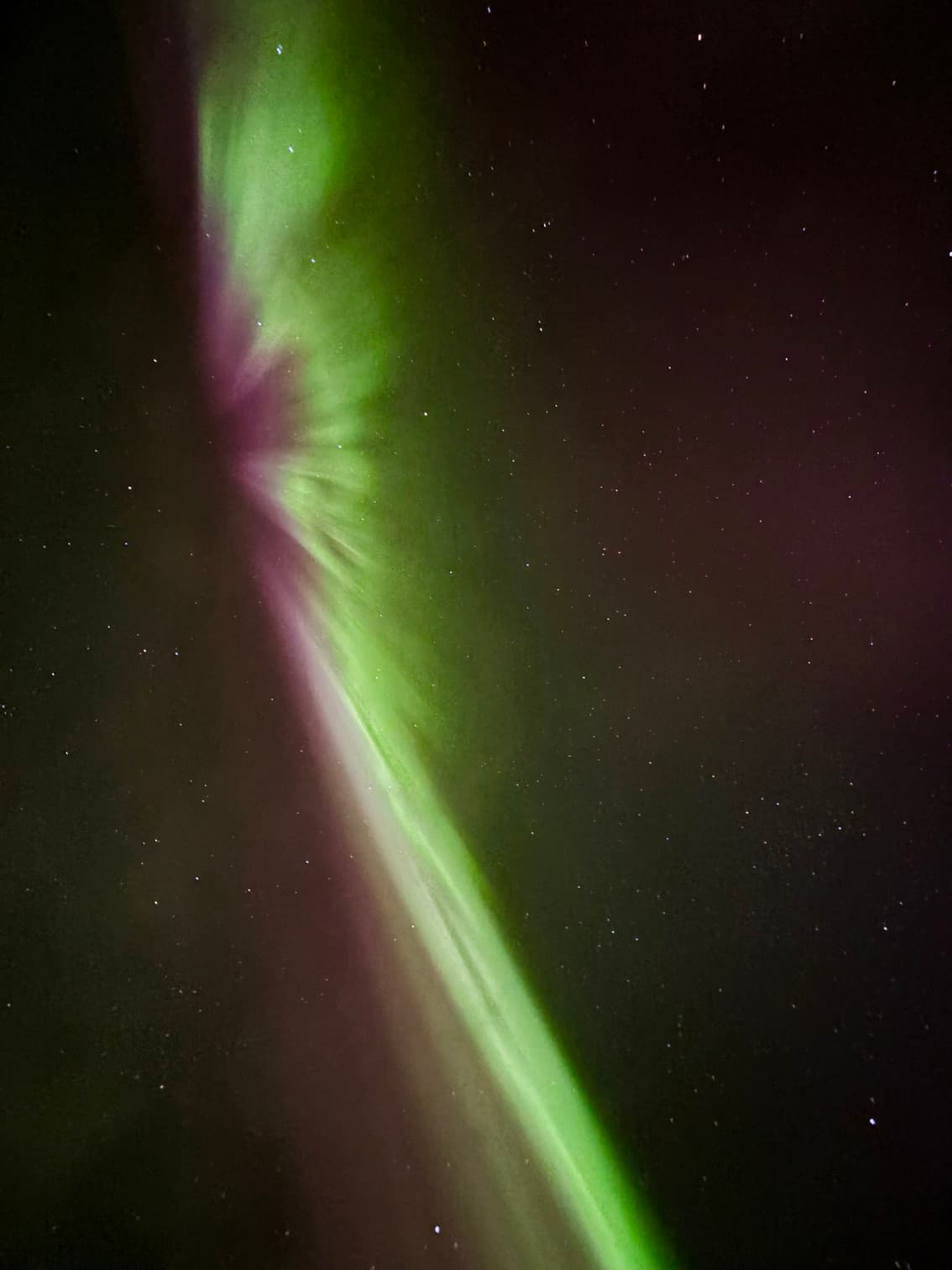
“Oh my god, it’s turning pink,” Ginny said under the pink-green aurora. The wind up there seemed to shift direction and what we saw was no longer a long stripe from one end to the other, but more like a bell curve with the green light on the outside and the pink-magenta light on the inside, both colors growing extremely strong in luminosity and intensity. Soon enough, we were right under two curved ribbons of northern lights, so bright and neon that they blocked the shiny stars behind them. The colors were so milky yet fluorescent, as if God had brushed stripes of lime green and magenta with a mix of gouache and ground diamond dust.
“Why is it pink?” Joris asked.
In fact, different molecules result in different colors when struck by the sun’s charged particles. When the solar wind hits oxygen in our atmosphere, green light is emitted; when hitting nitrogen, purple light is emitted. And the pink light — falling between the spectrum of green and purple — is a rare and mesmerizing result of the solar wind hitting a mix of oxygen and nitrogen.
“It’s one of those times when science feels so romantic…” I said, my irises reflecting green and pink.
It’s true.
Here in Iceland, there’s romance in sauvage, and there’s beauty in rawness.